Monday, 22 July 2013

There Is Always a Story to Be Told


Day 20:

Today was a free day in Edinburgh.  We could use it for our research if we needed to, but we could also use it for travel or just to wander around a bit.  I decided to sleep late (yay!) and then do a little shopping in Edinburgh before I headed to the Storytelling Centre in Edinburgh to see what I could find out about their programs. 

Fortunately, I got really great deals on some clothes at Primark!  Unfortunately, the guy I talked to at the Scottish Storytelling Centre didn’t have too much extra information to share with me.  I told him that I was a graduate student doing research about storytelling and asked a few questions, and he told me that I would find all of the information I needed on the website and in the two brochures he gave me.  Their website is quite helpful, but I was hoping that going in person to talk to someone would give me more insight.  I bought my tickets for the ceilidh that night and browsed their gift shop.  I couldn’t even look around their cafe because there was a meeting of some type that I didn’t want to interrupt.  

I headed off to Starbucks to do a little work and enjoy some iced coffee before meeting up with my friends to head back to the storytelling ceilidh (gathering).  

Storytelling Centre for the Ceilidh


A storytelling ceilidh is a Scottish gathering that involves singing, dancing, and, in this case, storytelling.  The Scottish Storytelling Centre hosts a few each month, and we were lucky enough to be around for this one.  They feature one main teller who opens and closes each part of the evening and introduces the other tellers from the audience, almost as if he were an emcee.  It lasted almost two and a half hours and included stories, songs, and poems.  I really enjoyed the featured teller’s stories as well as the offerings from the guest tellers.  At the beginning, the featured teller passes a book around and audience members can sign up if they have something they wish to share.  Not everyone will be able to share on crowded nights (like this one was), but he tried to vary the line-up with stories and traditional Scottish songs, a lady playing the Celtic harp, and a woman reciting poetry.  I thoroughly enjoyed my time listening to the stories.  One man even combined storytelling with improv skills and asked for input from the audience about setting and plot points.  He then built the story around this input.  It was hilarious!

Featured Storyteller
One of the Guest Tellers
Celtic Harp


The centre, itself, is quite interesting with a story wall that showcases Scottish stories in dioramas for kids to interact with by opening and closing, sliding, etc.  


Interactive Stories
Exhibit that shows the importance and tradition of storytelling in Scotland


"Let There Be Light"

Day 19:

Inscription above the entrance to the Central Library
Our class began our library visits in Edinburgh today at the Central Library.  We had a presentation from the library workers who each told us about their departments, how the library system was set up, and what the Edinburgh Libraries had to offer its patrons.  The system is extremely impressive!  The system is divided into neighborhoods, which is similar to how many large systems in the United States divides into branches.  However, one major difference is that in Edinburgh the library often shares its space with the neighborhood offices, so community members can go to the library to take care of neighborhood issues.  This brings more traffic into the library, which is always a good thing!

The Central Library (as part of the Edinburgh Libraries) won the Bookseller Best Library Service Award in 2012 and was a finalist for the same award again in 2013.  They have hosted the EDGE conference for the past 4 years with great success.  The Edinburgh Libraries strive for a Gold Standard of customer service, and in search of the best possible customer experience they have enlisted the assistance of retail service and hospitality professionals to help them improve their customer relations.

The library system has developed programs such as Edinburgh Reads, which attracts up to 140 people on a regular basis by hosting authors, politicians, etc. as speakers.  Under this overall program (Edinburgh Reads), the libraries offer specific programming for all ages and circumstances:

Get Up and Go--for the over 50 crowd


Bookbug--a program including storytimes for birth to 3 year olds that is run by the Scotland Book Trust

Chatterbooks--a reading group for 8-11 year olds

Summer Reading Challenge--a challenge to read a certain number of books over the summer for school age kids

Reading Champion Project--a program geared towards kids in residential care (approximately 100 kids in 16 homes, aged 12-15) to have encouragement and a positive experience at the library

Glitz Lit--a program aimed toward girls that pairs books and beauty


In addition to all of the age-specific programming, the library system has a team of six people who work on their digital offerings.  They have a multiple websites that allow patrons 24/7 access to some of the library's services, eresources, events, social media, etc.  In fact, one of the team member's sole job is to be in charge of updating and maintaining the library's social media.  They are active on Facebook, You Tube, Flickr, Twitter (with 7,000 followers), RSS feeds, blogs, etc.  They are looking toward branching out onto Pinterest, Google +, and others.  They were the first library service in the UK to have a mobile app version of their Your Library website.

The library system offers ebooks, emagazines (through Zinio, which was the most popular eresource last year), Capital Collections (a heritage collection online that includes exhibitions and an image database), audiobooks, Library2Go, overdrive, etc.  The neighborhood libraries offer device classes for patrons if they need help with their Kindles or Nooks or other devices.

The coolest resource, in my opinion, is their newest resource, Our Town Stories.  This resource offers an online look at stories that are important to Edinburgh's local history and legend.  With these stories, the librarians gather information and images, which they then put into an online exhibition.  They offer "now and then" looks at streets and areas of the city.  Many of these stories are also featured in physical exhibits in the neighborhood libraries. 

All of this makes sense when you realize that Edinburgh has been recognized as a United Nations City of Literature, and in fact it was the first city recognized as such.  Just for trivia's sake, Melbourne, Australia, and Reykjavik, Iceland, are two other UN Cities of Literature.

Following the introduction to the library’s services, we had a tour (in which we got to go up on the gallery in the research room!!!) and saw the library’s treasures.  
Secret door to reach the gallery stairs
The gallery directly across from where I'm standing


During the treasures portion of our visit, we got to see 500 years’ worth of publishing history.  We saw a copy of a 1495 book by Aristotle that has a tooled leather cover (that was added later). It is written in Greek and includes very wide margins, which is a sign of very high quality since paper was at such a premium. 


We also saw a copy of a Bassandyne Bible, which is the first full Bible printed in Scotland.  It was printed in 1579, and every parish had to own a copy.  


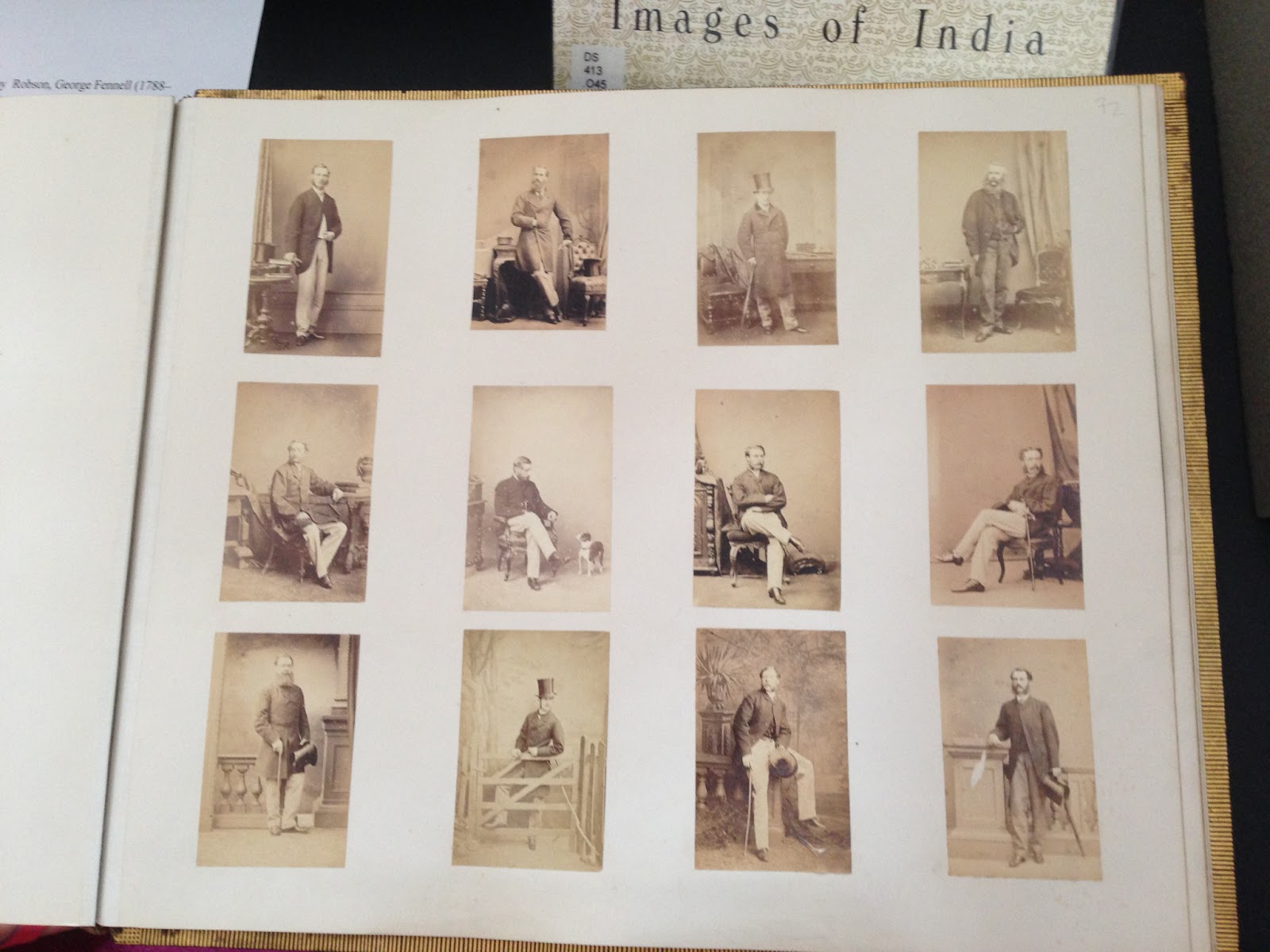
Then we saw the McDonald family photograph album.  The family had traveled to India and hired photographer Samuel Bourne to take pictures for their album.  The book includes pictures of India and family photographs in the back. 

McDonald Family
Page from the McDonald Album


The next treasure we saw was the first portable atlas of Scotland from 1776.  It is long and narrow, so you would see what you needed to see in the first pane, then move on to the next pane. 


*   *   *


We took a quick break to have lunch and then headed to New College Library for our afternoon appointment.  The New College Library is an academic library that focuses primarily on the Divinity School.  It holds over 250,000 books in 5 floors.  They use two different classification systems:  Library of Congress for the more modern acquisitions and Union Theological Seminary Scheme Classification for the older items.  

View from just outside the New College Library

We took a tour of the stacks, including two that are open to the public and one that is usually only available to staff members.  The library has an Archive Room which holds archival items related to the maintenance of the library and a Bible Room which is full of Bibles.  There are 631 Bibles in one special collection of Bibles, but that is just a fraction of the total number of Bibles in the total collection at New College Library. 

In our trip through the stacks, we saw items such as a Torah, a Bible written in Sanskrit, the history of British America, a book by John Calvin, and more!


After our tour, the librarian told us about the history of the library.  The building used to be a church, and it still maintains much of the church’s decor.  The stained glass windows were completed in 1934, just as the congregation was moving out.  The church pews have been turned into library desks and shelves.  


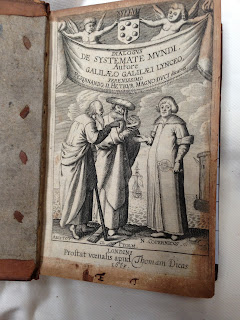
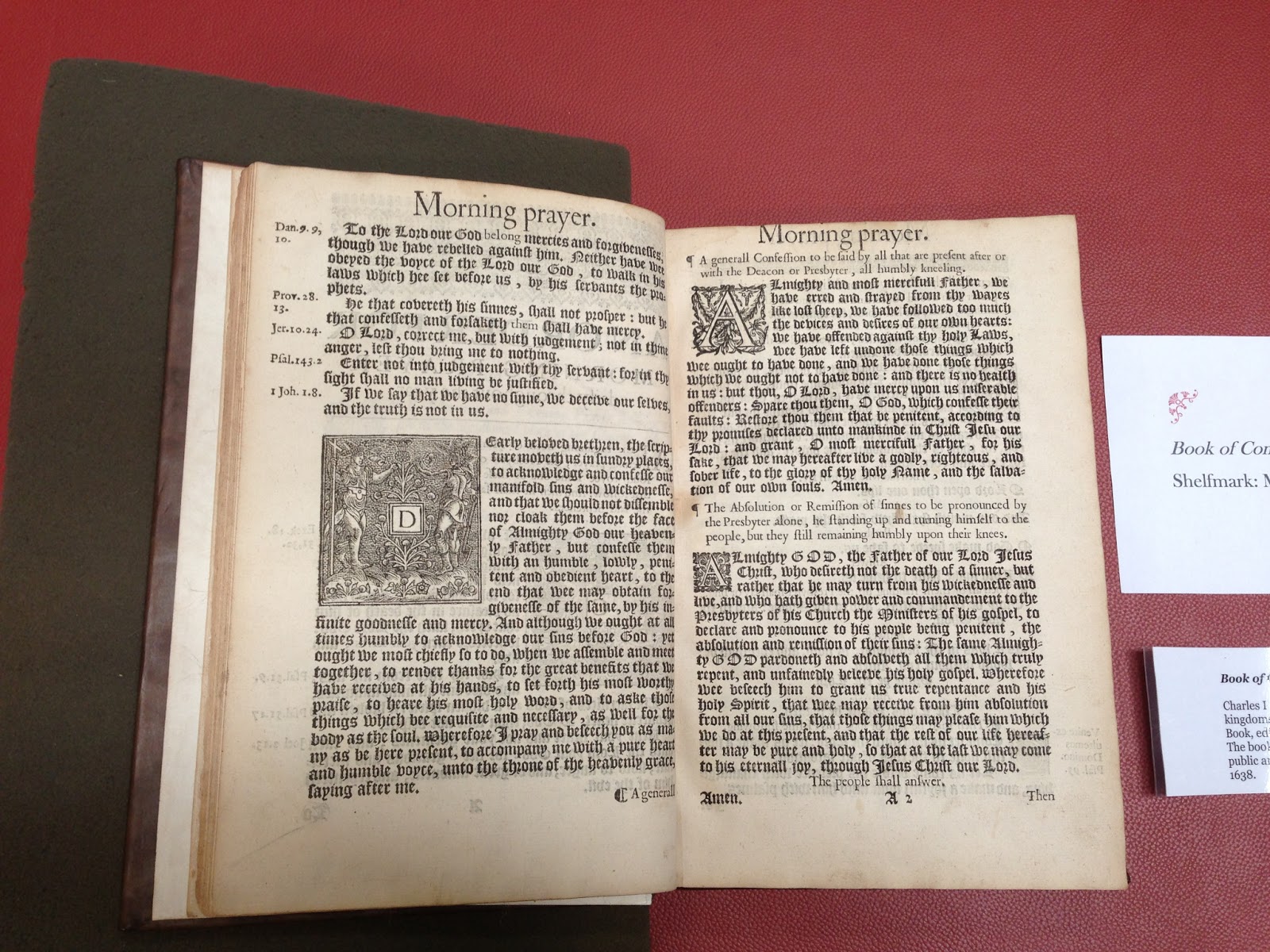
We had the privilege of seeing some of their treasures, as well.  

Book of Common Prayer from 1636


Galileo's Dialogus de Systemate Mundi from 1663

The Holy Bible from 1611


Monday, 15 July 2013

What Is a Hairy Coo, Anyway?!

Day 18:

This morning I got up a little ahead of schedule and ate a banana for breakfast while enjoying the view outside the house here at Dalkeith.  Then another student and I decided to walk across the bridge in search of the Hairy Coo and just to see what else we could discover.  Last night we had explored the house and found secret passage doors and rooms downstairs, so who knew what kinds of things we might find today!


Montagu Bridge
View from Montagu Bridge


Montagu Bridge from Below
As we headed into Dalkeith to the bus stop to start our day in Edinburgh, I decided to be adventurous and try a cheese and onion pasty for breakfast.  It was quite delicious...it tasted almost like a pierogi.  I think it must have had mashed potatoes in it.  I was careful to pay close attention to road signs on our way into Edinburgh since I'll be driving later this week.  I need to know what they all mean, so I don't end up in a ditch!

Our bus ride took just over a half hour, and then we did a little shopping before we headed to the National Library of Scotland  for a self-guided tour of their exhibits.  The first one I went through was the Jane Austen exhibit.  It contained a first edition (in three volumes) of Pride and Prejudice from 1813, a dress, gloves, and other books and films that have modified the story in some way.    There was also an area where visitors could leave their own comments and thoughts about the novel and the display.


Just beyond the Jane Austen exhibit, was the Picturing Africa display which had letters, journals, maps, paintings and drawings, and glass lantern slides from and relating to David Livingstone's time in Africa.  This exhibit was of particular interest to me since I had just seen Livingstone's actual artifacts at the Royal Geographic Society last week.  I enjoyed seeing his maps and trying to locate the different areas using the large magnifying glasses.

After looking around the National Library of Scotland, we passed by Greyfriars Bobby and learned the story of the pub and the statue.  Apparently, there was a police constable who had a dog named Bobby.  Bobby was a very loyal and protective dog, and he went everywhere with the police constable.  The constable died one day, and the dog mourned his owner's death for fourteen years until his own death.  There is now a statue and a pub named for Bobby.


 After seeing Greyfriars Bobby, we headed out to see the Elephant House pub, which is where J.K. Rowling wrote much of the Harry Potter series.  We took photos outside and then went to another nearby pub for lunch.

Where J.K. Rowling wrote Harry Potter
The Elephant House window


Following lunch on our own, we met up at the Duke of Wellington statue just outside of the National Records of Scotland building for our appointment there.  On our way there, we saw Edinburgh Castle in the distance!

Duke of Wellington...with a bird on his head...
Our appointment with the National Records of Scotland was really interesting.  We learned that the building was built in the late 1780s for the express purpose of housing records.  It's known for its dome (the Adam Dome).  This building is one of three buildings that house Scotland's records and is the only one available to the public.  The other two buildings are only open to staff.  One of the more modern buildings is Thomas Thomson House, which was constructed in 1995 for record storage.  It is climate-controlled and has a conservation center and a box-making facility on site.  

The organization used to be known as the National Archives, but they just recently merged with the General Registrar and are now collectively known as the National records of Scotland.  Their website is a portal that can link users to all of their different services and describe the different functions of each of the departments.  Family history research is a huge part of their work, and researchers can do some of their searching from home by buying credits to gain access to the Scotland People website.  On this website, researchers can search birth, death, and marriage records, census records, church and parish records, wills and testaments, and other business and legal documents.  Since many of the documents are handwritten, there is even a website to help you read the Scottish handwriting, vocabulary, alphabet, etc.  Check out the handwriting tutorial website for more information!  If you still need more help and you're in the Edinburgh area, the NRS offers a night class about Scottish handwriting at Edinburgh University.

Tartans and plaids are a big deal in Scotland, and they are for sale in every shop on every street almost.  However, if your family has a particular plaid, you want to make sure that it is authentic.  The Scottish Register of Tartans will not only show you what tartans are available, but it will also allow you to register your own design if it meets the specifications. 

If you know that your family is from a particular area of Scotland or you plan on visiting Scotland and you want more information about that area, you might want to try checking out the Scotland Places website which gives local history about counties, or shires, in Scotland. 

The NRS maintains records that date from the 12th century, with the oldest item being a brieve from King David I from 1120s which grants land to build a church near Edinburgh Castle.  Users access electronic material instead of the original in most cases.  This means that they have had a huge push toward digitization in recent years, but even though much of their collection is digitized users can still only access the Virtual Volumes on site and not from home yet.  

Formal registration began in 1855, so government records after that are much more complete than the church or parish records that precede them.  Additionally, after 1855 the records would be kept in a standard format and not just in whatever way the church record-keepers felt like it.  They have wills dating from the 1530s to the present and census records from 1841-1911.  

Researchers coming in need a Reader's Ticket, which requires identification and two passport photographs.  They must also follow a certain set of guidelines for using the Search Rooms (no pens, no food or drink, no cell phones or cameras, etc.).  This ticket can be renewed every three years as needed.  If you need material, you contact the librarians in advance so that they can locate the material and bring it from the other sites if necessary.

We got to see some of their more interesting records, such as a book of letters from 1513 between King Louis XII and King James of Scotland detailing their cooperation against the British.  We also got to see a book of household accounts dating from 1673 that lists golf balls and golf clubs as some of the items the young master of the house needs to purchase along with wig powder and clothing.  Another interesting item were maps and plans to improve Callendar that showed how they would divide up the new fews (plots) and the old fews on the acreage.

One item was particularly interesting to me because it was a receipt for a person's arrival to Accomack, VA.  Apparently, people were sometimes sent to the United States not exactly by choice, but by "transportation" and upon arrival in the US, someone sent a letter (like the one we saw) back to Scotland noting their receipt. 

On my way out of the NRS, I double-checked the books they have available for sale to see if McDaniel was listed under any of the McDonald clans.  I had been unable to find it in any of the other books.  Finally, I found it!!!!!! Yay!  My father will be so excited!  In fact, I was so excited that I did a little dance...right there in the lobby of the National Records of Scotland!  After a little more shopping, my time in Edinburgh was complete for today and I headed back to Dalkeith for more adventures!

We stumbled upon the Dalkeith Library just as we got off the bus back in Dalkeith, so we decided to head in and see what it was like.  The librarian was particularly friendly and told us all about the different things we could find on our walks at Dalkeith Palace.  We grabbed another delicious dinner of minestrone soup and cheesy garlic bread (it was so yummy last night, I decided that I would do it again tonight!) and ate outside in the fresh air.  Once we were finished with dinner we went on a quest to find the Hairy Coo!  We passed fields and walked down paths and through brambles.  We passed stables and found an orangerie.  We crossed a bridge, and there it was--THE COO!!  It was quite a shy coo, though.  It kept turning away from us when we wanted to take his picture, but we found the hairy coo!  He's quite adorable :)  We stayed and watched the Hairy Coo for a while, and then we continued exploring.  We found an old amphitheater and a rabbit.  Here are some pictures from our adventure!

Orangerie


Hairy Coo!!!!!! (It's a Highland Cow, kind of like a Yak, I believe)


Sunday, 14 July 2013

Goodbye, England! Hello, Scotland!

Day 17:

So we were on a bus for nine hours today.  I didn't have much to do except take pictures of the scenery going by, so here are some of those pictures.  Once we got here, we got our rooms at Dalkeith Palace (a old manor house that belonged to a Duke that sits on 800 acres of woods and fields), took a little walk to the bus stop, got dinner at a local pizza place (YUMMY minestrone soup and garlic cheese bread!!), and came back to explore the palace a bit.  We found a secret passage in our room and checked to see if it went to Narnia or to the Room of Requirement or anywhere else particularly exciting (it didn't...sadly).  Tomorrow, we'll venture into Edinburgh to start our library tours and other adventures!

Hay Bales in Northern England
View from the bus window


More sheep
Field and Sky


Hay Stacks


Windmills

Dalkeith Palace (my home for the next few days)
Secret Passage behind my bed!