Day 11:
Today we visited the London Archeological Archive Research
Centre (LAARC) at the Mortimer Wheeler Building.
This is where all of the Museum of London’s
items that aren’t on display live.
It
used to be a steel tubing warehouse, so they had to work around that structure
when they turned it into LAARC.
We
started in the Social and Working History Collections section that included
toys and games.
The archive collects all
items that have ever been used in London or have been connected to London in
some way.
They do not have duplicate
items, and each item is numbered and cataloged in Mimsy (which is their
cataloging system).
Their storage rooms
have sensors that send environmental information to a control system that can
adjust as necessary.
 |
| A look into the storage room |
They have everything from Legos and matchbox cars to
dollhouse furniture and puppets.
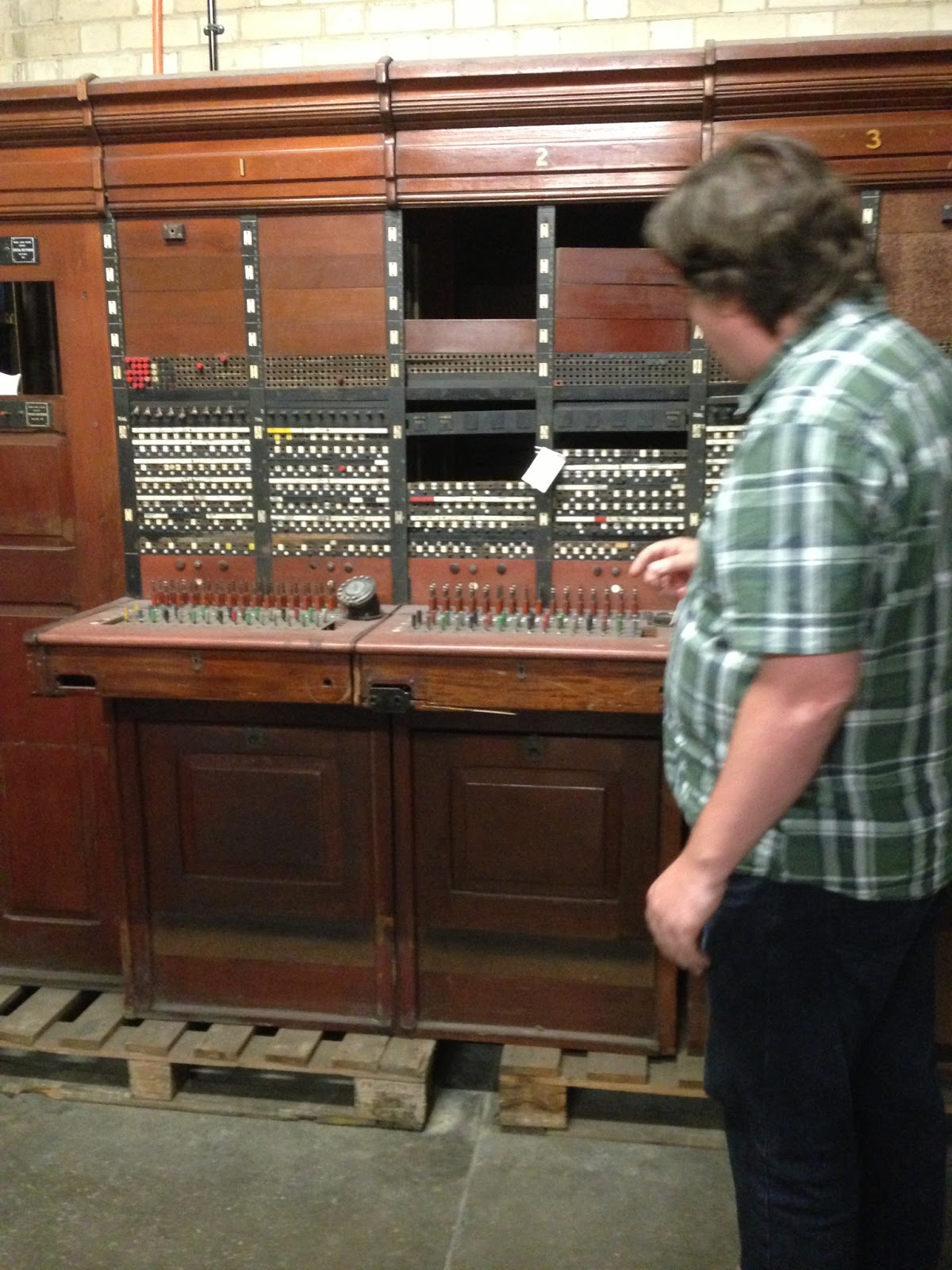
Included in this area is a large telephone operator’s switchboard that
used to belong at Buckingham Palace. The
lines are still labeled for the Queen’s rooms and the Palace staff. They are deciding whether to display it under
its current conditions or to conserve and restore it before they display it
somewhere. While they make those
decisions, it sits in the storage area at LAARC.
 |
| Buckingham Palace Switchboard |
In another area, the shelves hold parts of the interiors of
buildings. The process for moving those pieces is to deconstruct the building,
number and label each piece, and then reconstruct the pieces at a later
date.
The pieces we saw were still
labeled to show their building of origin.
The pieces in the storage area are available to researchers by
appointment, and they have a little bit of everything that one might think to
research.
The halls house the items that
are too large or too heavy to move, such as a gold weighing machine.
 |
| Floor tiles from a deconstructed building |
 |
| Labeled piece of the Granville Theatre |
LAARC has a conservation room complete with a hospital-grade
x-ray machine. All metal items are
x-rayed when they arrive so that the archaeologists can see any
etchings or engraving on the surface of the pieces.
The oldest pieces at at the archive were the prehistoric
flints, axeheads or arrowheads, that had been excavated at Heathrow Airport. These prehistoric flints
are kept in cabinets in the hallway on the route to the processing area. The van drivers visit excavations and bring
the loads of stuff there for processing.
Each bag is coded with a 3-letter/2-number code (eg, BZY 10). The letters refer to the streets or area
where the material was excavated, and the number refers to the year the
excavation began (not the year it was actually found). Also on the labels is a context number, which
indicates the 3D position in the ground of the object. The researchers want to be able to
reconstruct the stratigraphy (layers in the ground) of the dig at a later
date. The description of the find is
included on the label so that later users will know what they are seeing.
I found it interesting that waterlogged conditions are
excellent for preserving wood, leather, bones, etc.
Their current excavation site is known in the BBC as the
“Pompeii of the North” because the material they are processing is
in such good condition.
Bags of known
material are not the only things brought back for processing.
Buckets of soil samples are also returned to
LAARC to be sifted to find seeds, small bones, etc. and those small pieces from
the soil can tell researchers about eating habits of the people living there.
From each dig, researchers also collect
3-4-meter long soil cores to study.
 |
| Soil Cores |
|
 |
| A "Chicken Feeder," Perhaps |
Having family members who enjoy relic hunting back home, I
kept thinking about how much they would drool over talking to these experts and
seeing the processing area and all of the boxes of materials they have
found.
As we were wandering through, we saw one of the
researchers who was in the middle of processing some of his finds from his most
recent find. He stopped to show us what
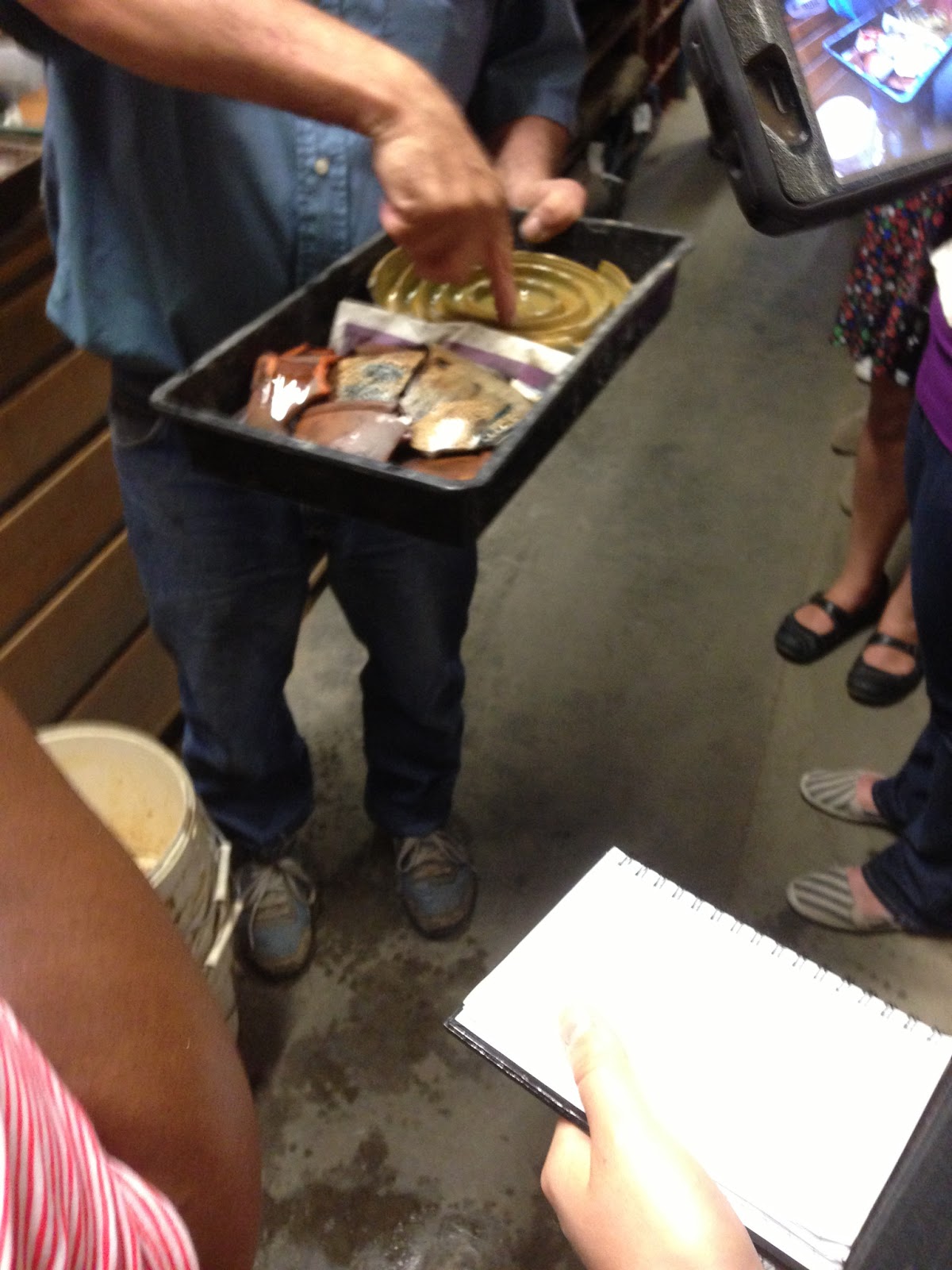
he was working on and tell us about what he had found. He was excited to be working on a 17th
century site instead of the Roman sites he had been working on for so long. He showed us a porridge dish that was made of tin instead of iron, door handles that were wooden and iron, spindles, glazed pots that had been through a double firing process (new technology for the time), decorated stoneware, and what he thinks is a chicken feeder. The next step in processing the material is drying it. Most material is air dried or oven dried. The researcher showed us some of the stuff from his find that was in the process of drying: shears, spoons that had the owner's initials on the top, a cloth seal (that was pinned to the cloth and gives the clothes' place of origin), and a needle.
 |
| More of the finds from the 17th century dig |
Once we left the processing area, we headed up to the archive storage area. We passed a stone cannonball which had been excavated at The Theatre. Our guide told us that every Shakespeare theatre excavation had included a stone cannonball, which they believe was a prop used to create weather noises (such as thunder) when rolled across the floor.
LAARC is the world's largest archaeological archive, with 10.5 km. of shelving and that number is increasing daily. They run an extensive volunteer program on a 10 week basis, and then once their 10 weeks are up they can begin a longer program. Additionally, LAARC has work experience programs for teenagers and internships for college students. Mostly, the volunteers and interns repackage and catalog materials to make it easier to access by users.
The archive itself is organized by year, with bulk materials arranged around the outer edge. Each item has a card that includes location information and a scale drawing of the actual item. They keep a paper copy and a digital copy of these cards. They also maintain a physical file that includes the original plans of each dig. The location of each find, stratigraphy information, and provenance documentation for each item is kept in these files. These are also kept digitally and on paper.
Pottery reference drawers allow users to see sample pieces of every type of pottery to compare the different ages and types. Each is labeled with a card indicating location, age, material, and other necessary information.
 |
| Pottery Reference Drawer |
One piece in the collection a few years ago had a very specific plan in case of a fire. The Lord Mayor's Coach required specific workers to report to the left wheel, the right wheel, the front to act has horses, etc. in case of a fire to evacuate it from the building.
They also have the top part of a boot found at the Rose Theatre, which is located next to the Globe Theatre. The boot is quite well-preserved and would have been worn by Shakespeare's contemporaries.
 |
| Top Piece of the Boot from the Rose Theatre |
The archives keep the material found at the dig site, but they also maintain the paperwork from the dig itself and photographs that documented the dig. They store journals, inventory lists of finds, budgets, weather conditions, site director's notes, etc. from each dig so that researchers can go back and find out information about the conditions of the find if necessary.
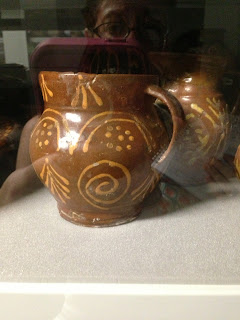
At the end of our tour, we went into the Ceramic and Glass Store, which is where the donations of ceramic and glassware are stored. These items have not been excavated, but instead have been given to the archive. They have everything from Roman pots to Frechen steins. Here are some of my favorites.


* * *
Tonight we went to the Open Air Theatre in Regent's Park to see Pride and Prejudice with a few girls from my flat. P&P is one of my favorite books, so I was looking forward to a little Darcy/Elizabeth Bennett fun in the park. The production was fantastic! Rob Heap, who plays Collins, stole the show with an over-exaggerated, "chicken-legged" version of the character. He was brilliant! The rest of the cast was excellent, too, but I adored his physical humor. Regent's Park, itself, was a beautiful setting for the play and for the walk to and from the theatre. I took pictures of the flower gardens near the entrance to the theatre.