Day 19:
 |
| Inscription above the entrance to the Central Library |
Our class began our library visits in Edinburgh today at the Central Library. We had a presentation from the library workers who each told us about their departments, how the library system was set up, and what the
Edinburgh Libraries had to offer its patrons. The system is extremely impressive! The system is divided into neighborhoods, which is similar to how many large systems in the United States divides into branches. However, one major difference is that in Edinburgh the library often shares its space with the neighborhood offices, so community members can go to the library to take care of neighborhood issues. This brings more traffic into the library, which is always a good thing!
The Central Library (as part of the Edinburgh Libraries) won the Bookseller Best Library Service Award in 2012 and was a finalist for the same award again in 2013. They have hosted the EDGE conference for the past 4 years with great success. The Edinburgh Libraries strive for a Gold Standard of customer service, and in search of the best possible customer experience they have enlisted the assistance of retail service and hospitality professionals to help them improve their customer relations.
The library system has developed programs such as Edinburgh Reads, which attracts up to 140 people on a regular basis by hosting authors, politicians, etc. as speakers. Under this overall program (Edinburgh Reads), the libraries offer specific programming for all ages and circumstances:
Get Up and Go--for the over 50 crowd
Bookbug--a program including storytimes for birth to 3 year olds that is run by the Scotland Book Trust
Chatterbooks--a reading group for 8-11 year olds
Summer Reading Challenge--a challenge to read a certain number of books over the summer for school age kids
Reading Champion Project--a program geared towards kids in residential care (approximately 100 kids in 16 homes, aged 12-15) to have encouragement and a positive experience at the library
Glitz Lit--a program aimed toward girls that pairs books and beauty
In addition to all of the age-specific programming, the library system has a team of six people who work on their digital offerings. They have a multiple websites that allow patrons 24/7 access to some of the library's services, eresources, events, social media, etc. In fact, one of the team member's sole job is to be in charge of updating and maintaining the library's social media. They are active on
Facebook, You Tube, Flickr, Twitter (with 7,000 followers), RSS feeds,
blogs, etc. They are looking toward branching out onto Pinterest, Google +, and others. They were the first library service in the UK to have a mobile app version of their Your Library website.
The library system offers ebooks, emagazines (through Zinio, which was the most popular eresource last year), Capital Collections (a heritage collection online that includes exhibitions and an image database), audiobooks, Library2Go, overdrive, etc. The neighborhood libraries offer device classes for patrons if they need help with their Kindles or Nooks or other devices.
The coolest resource, in my opinion, is their newest resource,
Our Town Stories. This resource offers an online look at stories that are
important to Edinburgh's local history and legend. With these stories,
the librarians gather information and images, which they then put into an
online exhibition. They offer "now and then" looks at streets
and areas of the city. Many of these stories are also featured in
physical exhibits in the neighborhood libraries.
All of this makes sense when you realize that Edinburgh has been recognized
as a United Nations City of Literature, and in fact it was the first city
recognized as such. Just for trivia's sake, Melbourne, Australia, and
Reykjavik, Iceland, are two other UN Cities of Literature.
Following the introduction to the library’s services, we had a tour (in
which we got to go up on the gallery in the research room!!!) and saw the
library’s treasures.
 |
| Secret door to reach the gallery stairs |
 |
| The gallery directly across from where I'm standing |
During the treasures portion of our visit, we got to see 500 years’ worth of
publishing history.
We saw a copy of a
1495 book by Aristotle that has a tooled leather cover (that was added later).
It is written in Greek and includes very wide margins, which is a sign of very
high quality since paper was at such a premium.
We also saw a copy of a Bassandyne Bible, which is the first full Bible
printed in Scotland.
It was printed in
1579, and every parish had to own a copy.
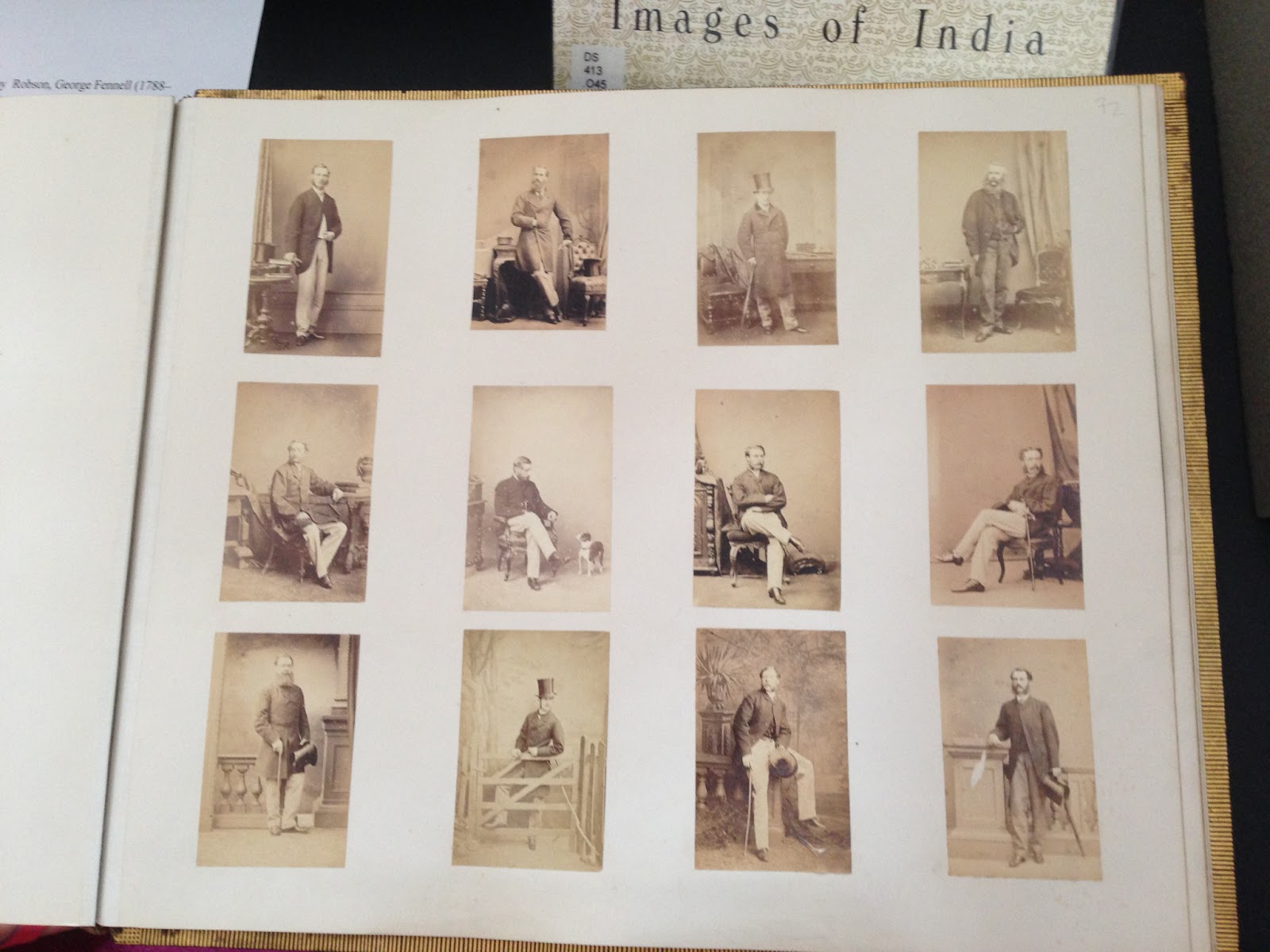
Then we saw the McDonald family photograph album.
The family had traveled to India and hired
photographer Samuel Bourne to take pictures for their album.
The book includes pictures of India and
family photographs in the back.
 |
| McDonald Family |
 |
| Page from the McDonald Album |
The next treasure we saw was the first portable atlas of Scotland from
1776.
It is long and narrow, so you
would see what you needed to see in the first pane, then move on to the next
pane.
* * *
We took a quick break to have lunch and then headed to New College Library
for our afternoon appointment.
The New
College Library is an academic library that focuses primarily on the Divinity
School.
It holds over 250,000 books in 5
floors.
They use two different
classification systems:
Library of
Congress for the more modern acquisitions and Union Theological Seminary Scheme
Classification for the older items.
 |
| View from just outside the New College Library |
We took a tour of the stacks, including two that are open to the public and
one that is usually only available to staff members.
The library has an Archive Room which holds
archival items related to the maintenance of the library and a Bible Room which
is full of Bibles.
There are 631 Bibles
in one special collection of Bibles, but that is just a fraction of the total
number of Bibles in the total collection at New College Library.
In our trip through the stacks, we saw items such as a Torah, a Bible
written in Sanskrit, the history of British America, a book by John Calvin, and more!


After our tour, the librarian told us about the history of the library.
The building used to be a church, and it
still maintains much of the church’s decor.
The stained glass windows were completed in 1934, just as the
congregation was moving out.
The church
pews have been turned into library desks and shelves.
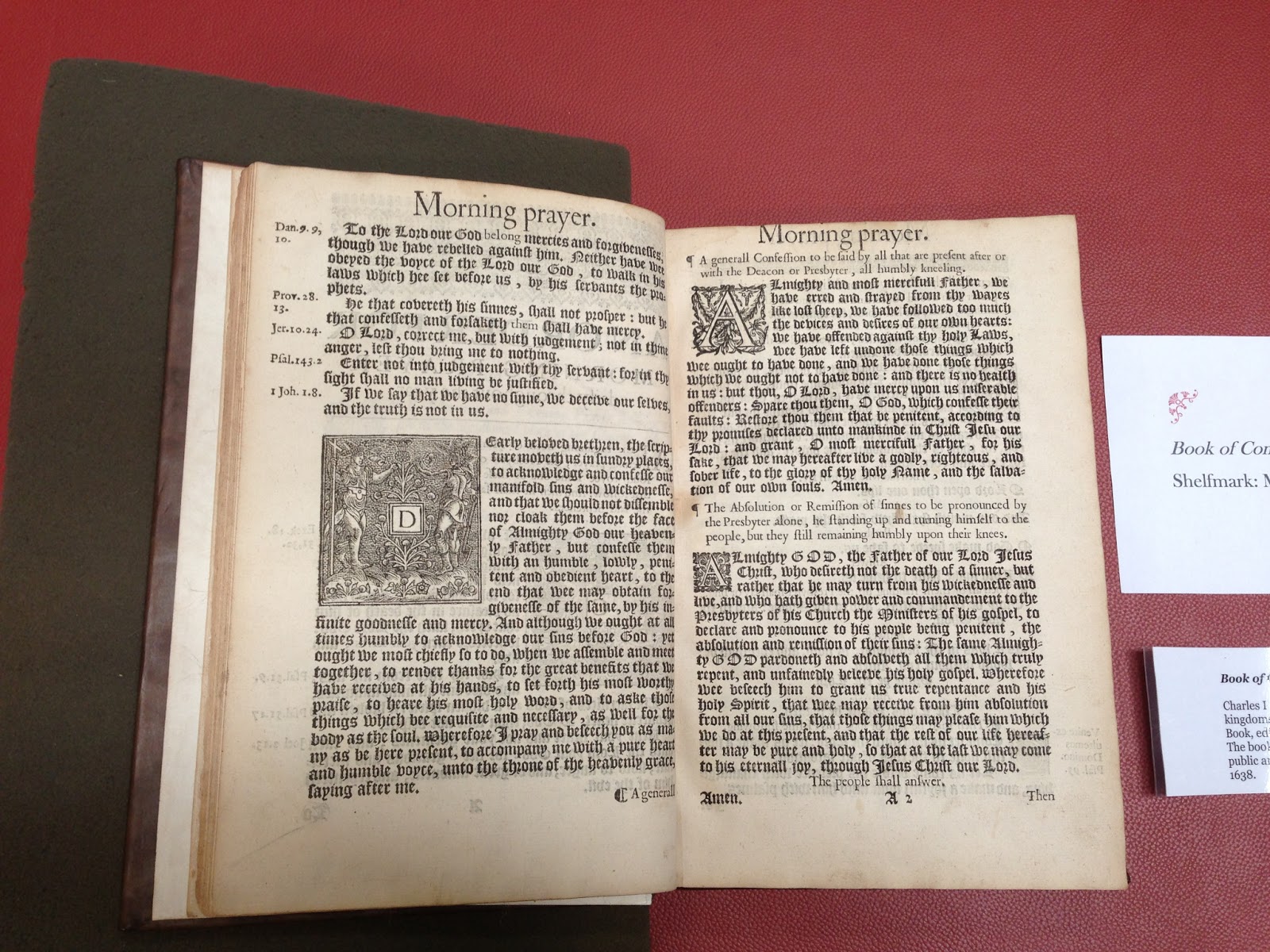
We had the privilege of seeing some of their treasures, as well.
 |
| Book of Common Prayer from 1636 |
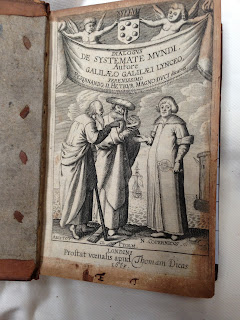 |
| Galileo's Dialogus de Systemate Mundi from 1663 |
 |
| The Holy Bible from 1611 |