Thursday, 11 July 2013

Victoria, Albert, and Jack

Day 13:

After a late night getting back from Stratford last night, we are off bright and early for the Victoria & Albert Museum (or the V&A) and the National Art Library.  I was stunned immediately upon walking into the Rotunda by the Chihuly sculpture hanging from the ceiling.  There had been a Chihuly exhibit at the Virginia Museum of Fine Arts this past year, but I didn't get a chance to see it.  I am glad I got to see this piece, though, because it is spectacular!

Chihuly piece
We headed upstairs for our meeting with the assistant librarian of the National Art Library.  She told us a little about the library itself and how it is set up.  The collections cover approximately 1 million items relating to art.  The library serves three functions.  First, it is a reading room for the V&A.  Second, it is the research library for V&A staff. Finally, the librarians act as curators for the V&A materials.  They collect books as art pieces as well as for their content. 

National Art Library Reading Room
Reading Room View from Above


About 30,000 visitors use the library each year.  Of those, about half are art or design students.  The rest are academics (teachers or students in other fields), genealogists, researchers looking for information about provenance of an item.  Because they do not have open access stacks, users must request materials ahead of time online.  Users can reserve materials for up to three days, if necessary.  Additionally, users have access to electronic databases such as JSTOR, but they are only available on site.  However, they are working to change this in the near future.  The library's collection includes 11,000 periodicals from common magazines such as Vogue, Harper's, or Tattler to journals that are more specific to the art world such as Art Journal or Atheneum.  They have some complete runs of periodicals, too, which is a rarity.

They have a yearly acquisitions budget that is 170,000 pound, but most of their items still mainly come from donations. One donation from the Foster family gave the library 11,000 items.  Within this bequest was a Dickens manuscript, a 1st Folio from William Shakespeare, a poem by Keats, and DaVinci Codices. 

After showing us around the library, our guide showed us some of the library's treasures.  We got to see an illuminated manuscript from 1400.  The Book of Hours includes 10 miniatures and would have included 10 more, but someone removed them many years ago to display them separately.  The book has been rebound in both the 18th and 20th centuries, and it has the binding history in the back which is not always the case. 

Next, she told us about a facsimile of a Leonardo da Vinci codex that was created in 1992.  The original was from 1493-1505.  The facsimile itself is worth at least 20,000 pound. 

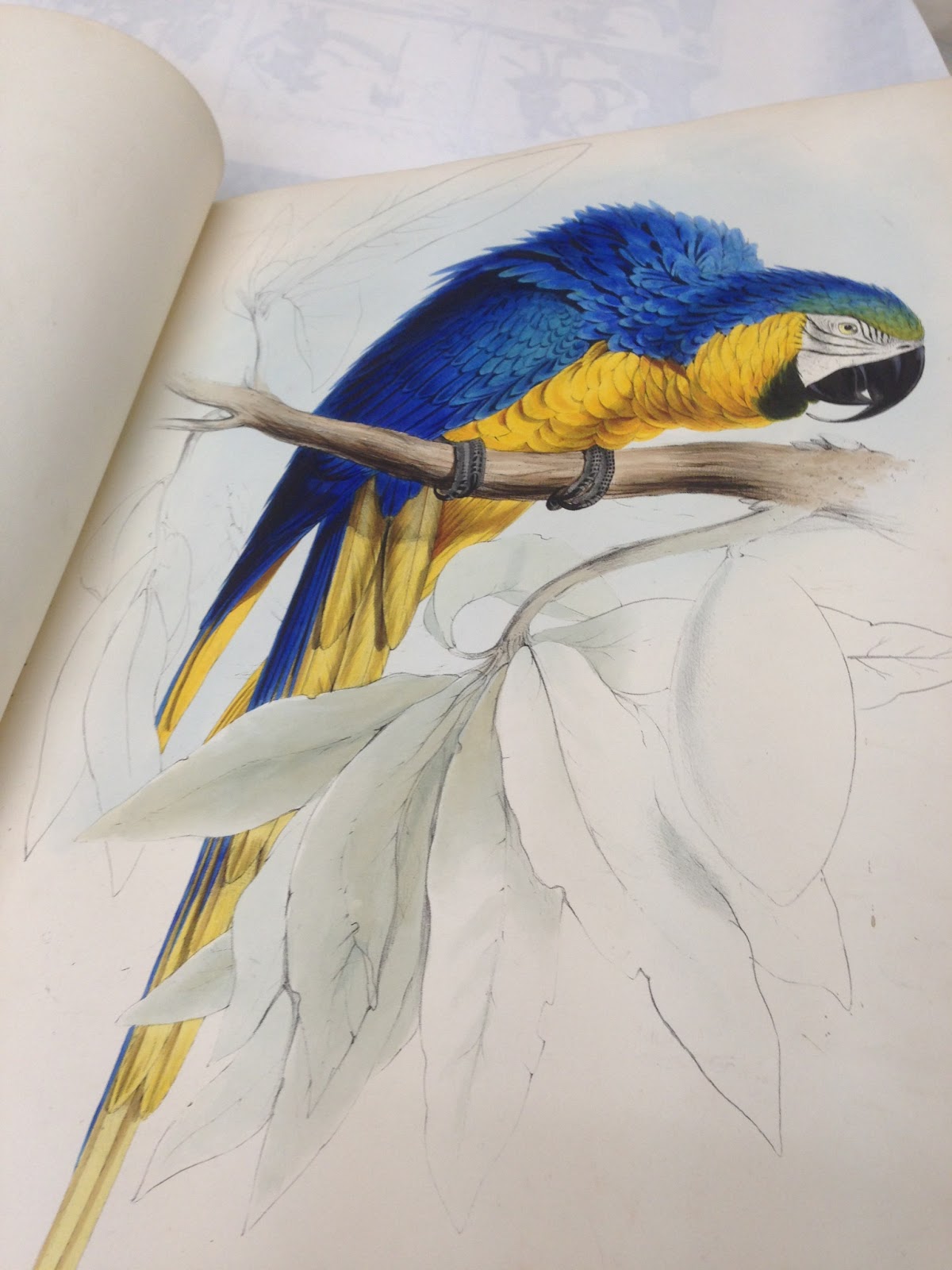
The next treasure she showed us was a book of lithographic plates.  The 42 pictures were published in 1832 by Edward Lear (most known as a limerick poet).  This book was his first publication, and he had subscribers give him money to help him cover the cost of publishing the book.  The list of subscribers is in the front of the book.  The lithographs are life-sized drawings of parrots that he drew from living birds instead of stuffed birds as others used.  Lear was compared to Audubon because of this book.  The drawings are so life-like, and the colors are vibrant.


 She showed us a box created by Geneviève Seillé in 1990.  It shows her interest in graffiti, medieval literature, magic, words, and letters.  There is no meaning or symbolism behind the "book item," which comes apart and is covered with writing and is full of hidden compartments and secrets. 


*   *   *
After the V&A, a few of us went to Hyde Park on an unsuccessful search for the statue of Colin Firth as Mr. Darcy that apparently has been put into the Serpentine there.  Sadly, we did not find it, so we came back to King's College to be productive for the rest of the afternoon since we were going on a Jack the Ripper Walk at night.  

The Jack the Ripper Walk began near the Tower of London and took us to a few of the sites of the murders, past the "Prostitutes' Church" where Jack picked up his victims (or they picked him up), to the site where the bloody knife was found with the cryptic message about the Jews, into the East End, and ended at the Ten Bells Pub where the final victim spent time drinking.  It lasted almost two hours, and our guide did not hold back on the graphic parts.  One person in our tour said, "Wow! I didn't realize that it would be so violent."  I'm not sure what she thought she would be getting when she took a tour of a serial killer's haunts, but I got what I paid for, I think.  The guide talked about the five victims (some people claim six victims, but most "Ripperologists" only count five), who they were and how they lived their lives.  He talked about the rivalry between the police forces, even sharing stories about police officers from one force dressing up as prostitutes and heading into the other force's territory to try to trap the killer and then getting arrested.  He showed us where bodies were found and explained what it would have looked like 123 years ago.  We saw the "Prostitutes' Church" and the old gates between the East End and the City of London.  At the end of the walk, he discussed the four main suspects considered by the police then.  None were ever convicted or even tried, so no one will ever know who Jack the Ripper really was.  The walk was really interesting, and it made me want to go read more about the subject.  

Old City Gates and the Prostitutes Church


"Do you not know that I am a woman? When I think, I must speak!" (As You Like It 3.2.240)

Day12:

As an English major and a language arts teacher, William Shakespeare is one of my favorite people.  That means Stratford-Upon-Avon is definitely a bucket-list kind of place for me.  I have been looking forward to going to Stratford for years, perhaps even decades!  The first thing I saw as we drove into town were Tudor-style houses.  As we reach the car park and disembark from the bus, I found myself getting excited to just walk the same streets as William and his family did so long ago.  As we reach the start of High Street, I notice a statue of a jester with quotes from a few of his plays inscribed around the base.

"On noble fool! A worthy fool!" ~As You Like It
We decided to wander down High Street and browse in some of the shops along the way.  We weren't really looking for anything in particular, just trying to see what was available.  I love that everything is so picturesque.


Eventually, we made it to the public library, and headed inside to see their children and young adult section.  After perusing their collection and picking up a few flyers about programming, we stopped to talk to a librarian at an information desk.  She told us that they didn't have a specific person responsible for the children/young adult section and that the library worked closely with the community to run programs.  I enjoyed talking with her and hearing more about the way public libraries work in the UK.  The four of us bought canvas bags, and she was really excited that we wanted to purchase them!  (They're really cute!)

Once we left the library, I picked up a lemon-poppyseed muffin (delicious!) in a local restaurant, and we carried on with our wanderings.  At the end of High Street, we decided to head toward Trinity Church, which is where William Shakespeare attended church and is buried.  The walk there along the river was lovely and relaxing.  There was a park where people were hanging out listening to music, the theatre we were going to see the play in later, the shops, the river with boats to rent, and a mini-golf course on the other side of the river.

The boats were named for Shakespeare's female characters.  There was no "Kate."

View of the Avon

When we reached the cemetery at Trinity Church, I noticed how peaceful and beautiful it was with the sunlight floating through the trees.  Again, I made my father proud by taking pictures of tombstones!  Here are some pictures from the cemetery and the exterior of the church:


This church is where William Shakespeare and his family attended.  He and his family are also buried here under the altar floor.  Shakespeare's grave has a curse inscribed on it that says, "Good friend for Jesus' sake forbear, to dig the dust enclosed here. Blessed be the man who spares these stones and cursed be the he who moves my bones."    Here are pictures of the interior of the church including Shakespeare's grave.


Shakespeare's grave with the curse.
 We left Trinity Church and headed back toward the main part of town to get an early dinner.  We decided to sit in the park and nap, read, or blog after eating our burgers and milkshakes.  Overall, the day was beyond relaxing and idyllic, which was exactly what I needed after a hectic Paris weekend!  When it was time for the play, I was ready to see a fantastic production of As You Like It, and the Royal Shakespeare Company certainly did not disappoint!

The production was not a traditional one, but that is what made it unique and wonderful!  The actors playing Rosalind and Orlando were brilliant and believable together. The costuming with the contrasting dark clothing for when in the duke's court and colorful for when in the Forest of Arden and set design using the rotating stage and the pit of gravel were clever and added to my overall experience.  I thoroughly enjoyed the production, and I was raving about it afterward.  The best thing I can say about the play is that I heard non-Shakespeare fans talking about how much fun it was and how much they had enjoyed it.  At the end of a long, but idyllic day, we headed back to the buses and began our journey back to London. 

Wednesday, 10 July 2013

Digging in the Dirt


Day 11:

Today we visited the London Archeological Archive Research Centre (LAARC) at the Mortimer Wheeler Building.  This is where all of the Museum of London’s items that aren’t on display live.  It used to be a steel tubing warehouse, so they had to work around that structure when they turned it into LAARC.  We started in the Social and Working History Collections section that included toys and games.  The archive collects all items that have ever been used in London or have been connected to London in some way.  They do not have duplicate items, and each item is numbered and cataloged in Mimsy (which is their cataloging system).  Their storage rooms have sensors that send environmental information to a control system that can adjust as necessary.  
A look into the storage room

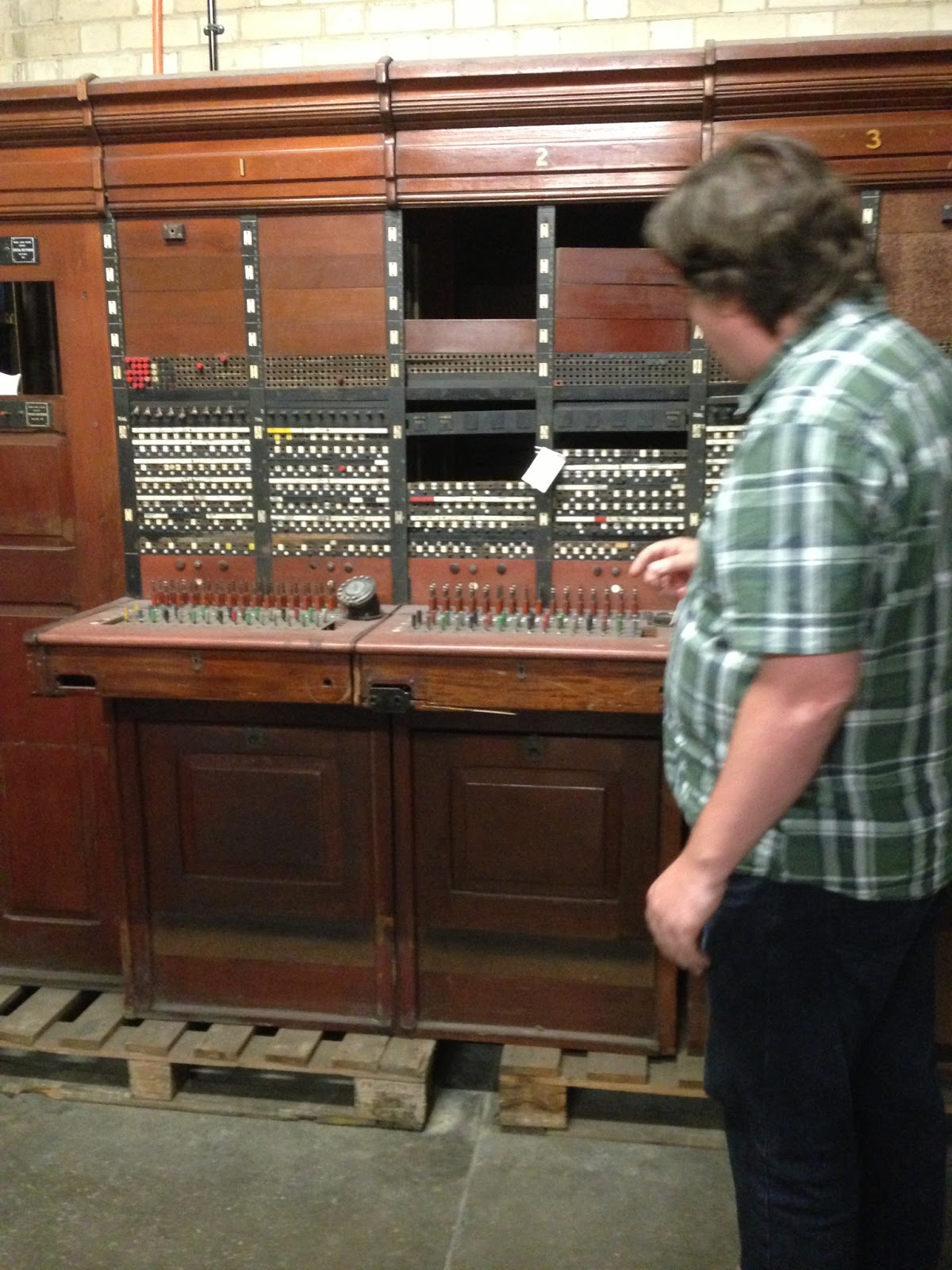
They have everything from Legos and matchbox cars to dollhouse furniture and puppets.  Included in this area is a large telephone operator’s switchboard that used to belong at Buckingham Palace.  The lines are still labeled for the Queen’s rooms and the Palace staff.  They are deciding whether to display it under its current conditions or to conserve and restore it before they display it somewhere.  While they make those decisions, it sits in the storage area at LAARC. 

Buckingham Palace Switchboard

In another area, the shelves hold parts of the interiors of buildings. The process for moving those pieces is to deconstruct the building, number and label each piece, and then reconstruct the pieces at a later date.  The pieces we saw were still labeled to show their building of origin.  The pieces in the storage area are available to researchers by appointment, and they have a little bit of everything that one might think to research.  The halls house the items that are too large or too heavy to move, such as a gold weighing machine.  

Floor tiles from a deconstructed building
Labeled piece of the Granville Theatre

LAARC has a conservation room complete with a hospital-grade x-ray machine.  All metal items are x-rayed when they arrive so that the archaeologists can see any etchings or engraving on the surface of the pieces. 

The oldest pieces at at the archive were the prehistoric flints, axeheads or arrowheads, that had been excavated at Heathrow Airport.   These prehistoric flints are kept in cabinets in the hallway on the route to the processing area.  The van drivers visit excavations and bring the loads of stuff there for processing.  Each bag is coded with a 3-letter/2-number code (eg, BZY 10).  The letters refer to the streets or area where the material was excavated, and the number refers to the year the excavation began (not the year it was actually found).  Also on the labels is a context number, which indicates the 3D position in the ground of the object.  The researchers want to be able to reconstruct the stratigraphy (layers in the ground) of the dig at a later date.   The description of the find is included on the label so that later users will know what they are seeing.  

I found it interesting that waterlogged conditions are excellent for preserving wood, leather, bones, etc.  Their current excavation site is known in the BBC as the “Pompeii of the North” because the material they are processing is in such good condition.  Bags of known material are not the only things brought back for processing.  Buckets of soil samples are also returned to LAARC to be sifted to find seeds, small bones, etc. and those small pieces from the soil can tell researchers about eating habits of the people living there.    From each dig, researchers also collect 3-4-meter long soil cores to study.  

Soil Cores
A "Chicken Feeder," Perhaps


Having family members who enjoy relic hunting back home, I kept thinking about how much they would drool over talking to these experts and seeing the processing area and all of the boxes of materials they have found. 

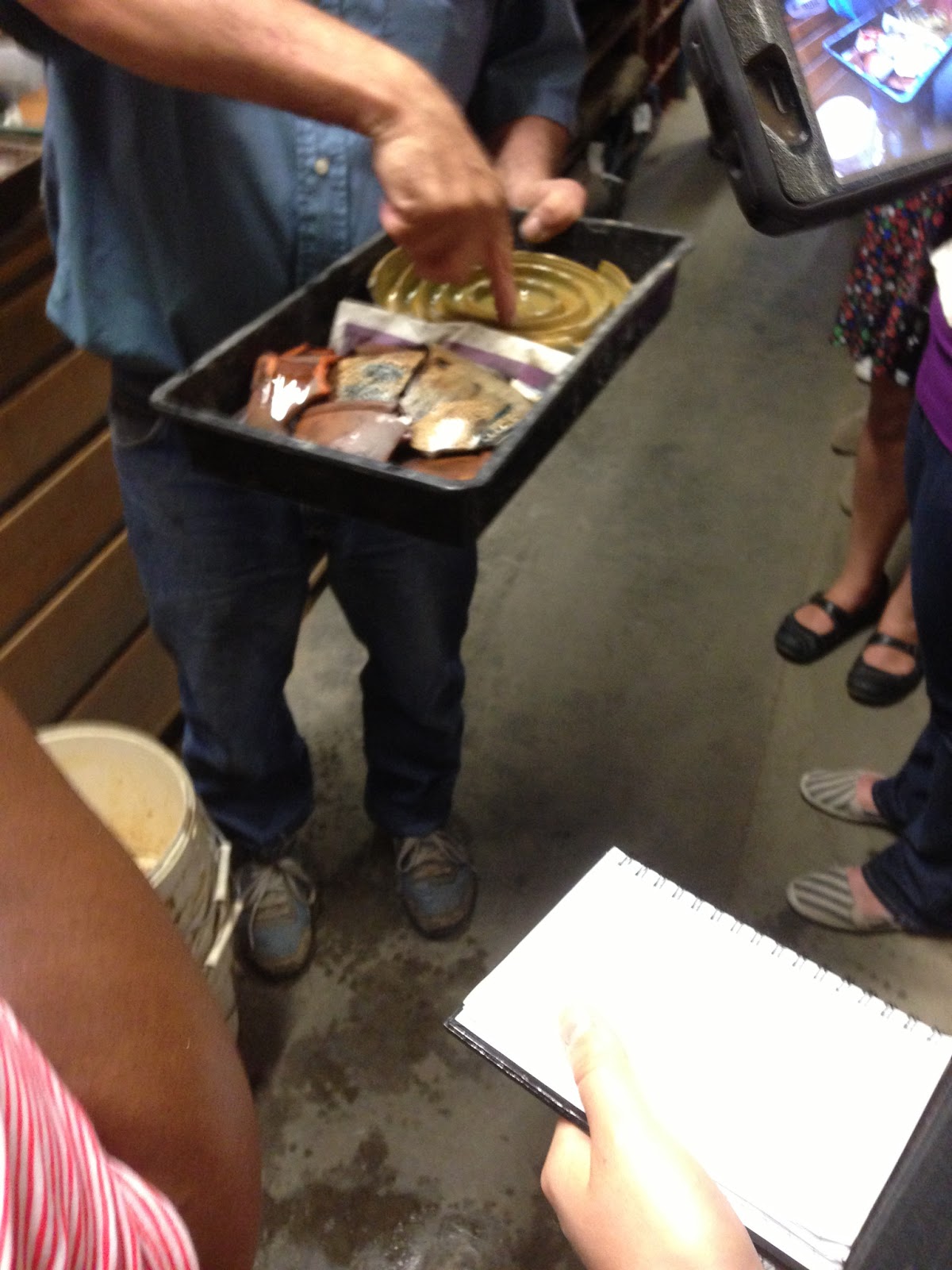
As we were wandering through, we saw one of the researchers who was in the middle of processing some of his finds from his most recent find.  He stopped to show us what he was working on and tell us about what he had found.  He was excited to be working on a 17th century site instead of the Roman sites he had been working on for so long.  He showed us a porridge dish that was made of tin instead of iron, door handles that were wooden and iron, spindles, glazed pots that had been through a double firing process (new technology for the time), decorated stoneware, and what he thinks is a chicken feeder.  The next step in processing the material is drying it.  Most material is air dried or oven dried.  The researcher showed us some of the stuff from his find that was in the process of drying: shears, spoons that had the owner's initials on the top, a cloth seal (that was pinned to the cloth and gives the clothes' place of origin), and a needle.  

More of the finds from the 17th century dig
 Once we left the processing area, we headed up to the archive storage area.  We passed a stone cannonball which had been excavated at The Theatre.  Our guide told us that every Shakespeare theatre excavation had included a stone cannonball, which they believe was a prop used to create weather noises (such as thunder) when rolled across the floor.  

LAARC is the world's largest archaeological archive, with 10.5 km. of shelving and that number is increasing daily.  They run an extensive volunteer program on a 10 week basis, and then once their 10 weeks are up they can begin a longer program.  Additionally, LAARC has work experience programs for teenagers and internships for college students.  Mostly, the volunteers and interns repackage and catalog materials to make it easier to access by users.  

The archive itself is organized by year, with bulk materials arranged around the outer edge.  Each item has a card that includes location information and a scale drawing of the actual item.  They keep a paper copy and a digital copy of these cards.  They also maintain a physical file that includes the original plans of each dig.  The location of each find, stratigraphy information, and provenance documentation for each item is kept in these files.  These are also kept digitally and on paper.

Pottery reference drawers allow users to see sample pieces of every type of pottery to compare the different ages and types.  Each is labeled with a card indicating location, age, material, and other necessary information.  

Pottery Reference Drawer
One piece in the collection a few years ago had a very specific plan in case of a fire.  The Lord Mayor's Coach required specific workers to report to the left wheel, the right wheel, the front to act has horses, etc. in case of a fire to evacuate it from the building.  

They also have the top part of a boot found at the Rose Theatre, which is located next to the Globe Theatre.  The boot is quite well-preserved and would have been worn by Shakespeare's contemporaries.  
Top Piece of the Boot from the Rose Theatre

The archives keep the material found at the dig site, but they also maintain the paperwork from the dig itself and photographs that documented the dig.  They store journals, inventory lists of finds, budgets, weather conditions, site director's notes, etc. from each dig so that researchers can go back and find out information about the conditions of the find if necessary.  

At the end of our tour, we went into the Ceramic and Glass Store, which is where the donations of ceramic and glassware are stored.  These items have not been excavated, but instead have been given to the archive.  They have everything from Roman pots to Frechen steins.  Here are some of my favorites.


*   *   *


Tonight we went to the Open Air Theatre in Regent's Park to see Pride and Prejudice with a few girls from my flat.  P&P is one of my favorite books, so I was looking forward to a little Darcy/Elizabeth Bennett fun in the park.  The production was fantastic!  Rob Heap, who plays Collins, stole the show with an over-exaggerated, "chicken-legged" version of the character.  He was brilliant!  The rest of the cast was excellent, too, but I adored his physical humor.  Regent's Park, itself, was a beautiful setting for the play and for the walk to and from the theatre.  I took pictures of the flower gardens near the entrance to the theatre.  


Paris, Ah, Paris (Part 2)

Days 9-10:

Paris Weekend, continued


Saturday morning I wake up, get ready, head back downstairs with all of my stuff (because the room I ended up in at 2am wasn’t where I was staying the whole weekend), and continue my scavenger hunt for beds.  This time, I get the help of one of the BSP leaders, which makes life way easier!  I get the right room, put my stuff away, and grab breakfast before heading off to Versailles for the morning.  Even though we had to get back on a bus after having been on a bus for so long just the day before, we figured getting to see the Palace at Versailles would be worth it!  As we are getting to the town, we notice black smoke billowing up above the trees.  We are looking to see from where it comes, and then we see that a car is on fire (not a little fire, a fully engaged ball of fire) in a parking lot! It was completely random!
Gates at Versailles

We arrive at Versailles and get in line.  We stand in line.  We continue to stand in line.  Impressively, though, the line seems to have organized itself into a serpentine line that works quite well and moves in an organized way almost like the Temple Grandin livestock lines do.  There are no barriers keeping people in line or indicating where the line should be.  There are no workers directing traffic, but still the line remains organized.  Clearly, we were in line a long time, because we had time to discuss this at length! 

Once we finally made it into Versailles, I saw the gorgeous gardens through the windows, but we didn’t have time to walk through them.  The rooms were elegant, plush, and ornate.  It was crowded, but overall the crowds moved well.  The only real bottleneck was in the Queen’s bedroom.   We probably could have spent longer at Versailles, but we had limited time and needed to get back to Paris for afternoon activities. 


Gardens at Versailles


Gardens at Versailles

One of our group members really wanted to see the catacombs, so we had decided to head there upon arrival back in Paris.  We had checked the website, mapped out our metro trip, and planned the rest of our day around that activity.  We start our marathon metro trip across the city, and the bad luck starts.  First, we realize that we had been looking at the wrong blue line, so one member of our group gets on the train thinking that she knows the right stop before we can tell her it’s not the right one.  None of the rest of us can fit on the train, so she’s on there by herself going to the wrong stop.  Another member of our group gets groped on the train and has to get off and catch the next train because she can’t get back to our car.  I almost get pick-pocketed walking down into the metro station the ONE time I have my bag on the back of my body instead of on the front of my body!  After riding an extremely crowded metro train for an hour, we arrive at the catacombs at 4:15.  They stop letting people in at 4.  Now, their website says they close at 5, but it says NOTHING about the fact that they don’t let people in after 4.  So, back on the metro, we go.  

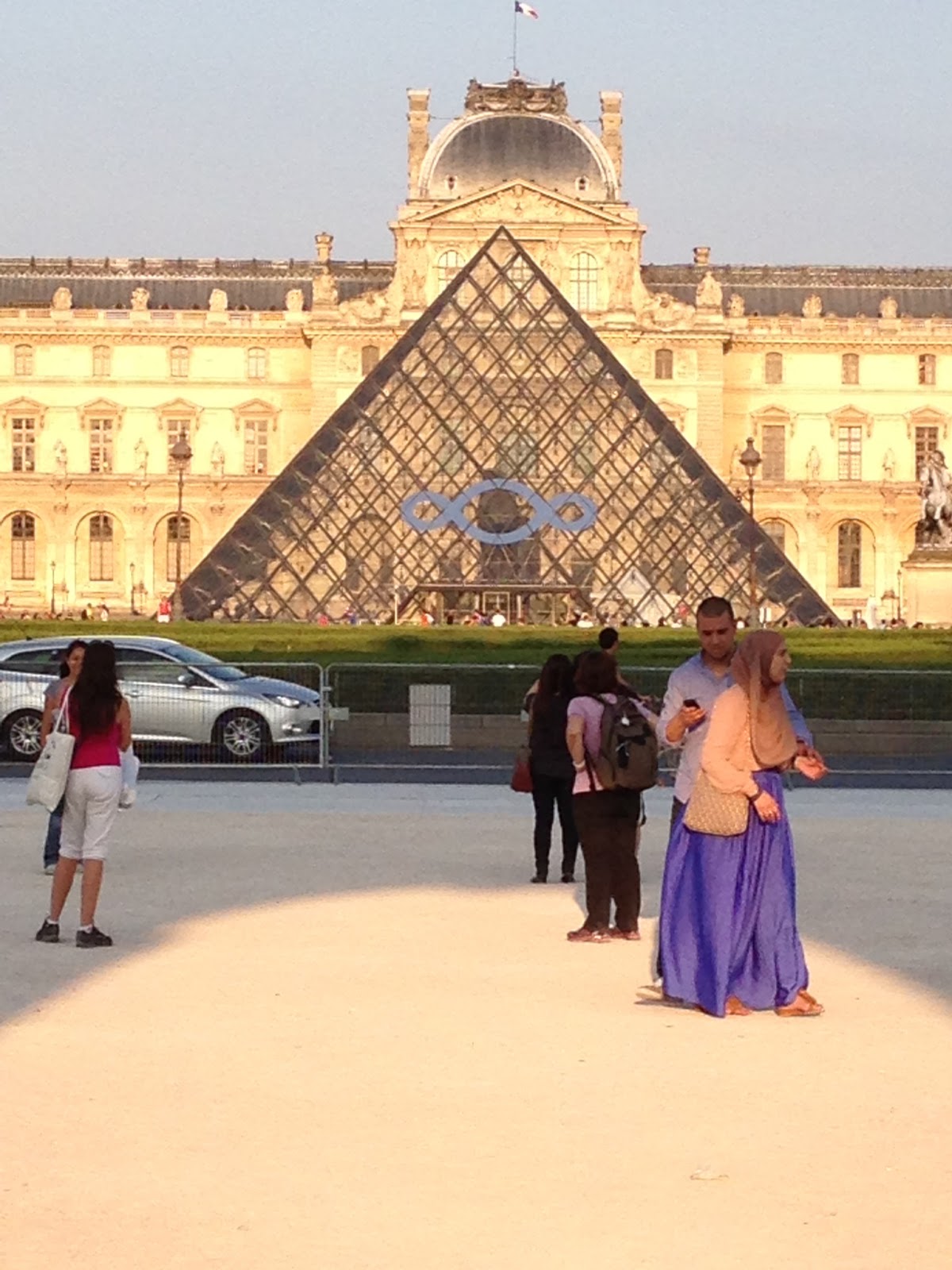
We headed back across the city to the Hard Rock Café for dinner because one of the girls in our group had that on her list of “must-do” things.  By this time, we were all tired and ready to just sit, eat, drink, and enjoy some music and each other’s company for a while.  After dinner, we walked back toward Pont Neuf and around the Louvre, where we were able to see the Arc de Triomphe off in the distance.
The Louvre Pyramid at Night
Arc de Triomphe du Carrousel in front of the Louvre (NOT the Arc de Triomphe de l'Etoile which is actually off in the background)


That night we did make it onto our boat trip on the Seine, which was a highlight of my trip!  I enjoyed seeing all of the people just sitting along the river banks waving and hanging out.  I loved seeing the bridges and the Eiffel Tower from the river.  When it was over, we sat on Pont Neuf again waiting for the Eiffel Tower to light up and sparkle again.  
Eiffel Tower View from the Seine

Michelle, Amanda, Me, Christina, and Liz on the boat trip!


We had a little more bad luck on the metro ride home, because one of our group didn’t make it on the train and got left on the platform.  We got off at the next stop to let her catch up with us, and it’s lucky we did!  In the next tunnel after we all were together again, the train stopped and the lights went out.  I’m sure if any of us had been alone on a subway train in Paris at 11:30pm in a tunnel when the lights go out, we would have freaked out just a little bit!  However, we were all 5 together, and now it’s just a part of our adventure.

Sunday morning, we got up, checked out, and headed off to the bakery for breakfast.  We also went to the coffee shop across from the bakery for some incredible café au lait.  The owner gave each of us a chocolate bar to go with our coffee, and I actually melted mine into my drink.  YUM!!  I ended my time in Paris by sitting on the canal by myself journalling about my trip and listening to music and the city while others in my group went to Moulin Rouge or back to the catacombs. 

After another bus, ferry, bus trip, we finally arrived back at “home” in London around 8pm Sunday night.  I can honestly say that there were parts of Paris that were beautiful.  I am glad I went because I would have always wondered, but I don’t really have any need to go back.  Our little group laughed and had good times, but we definitely like London much better than Paris!!